Showing posts with label nude. Show all posts

Monday, 7 February 2022

I'm writing a creative photography book!


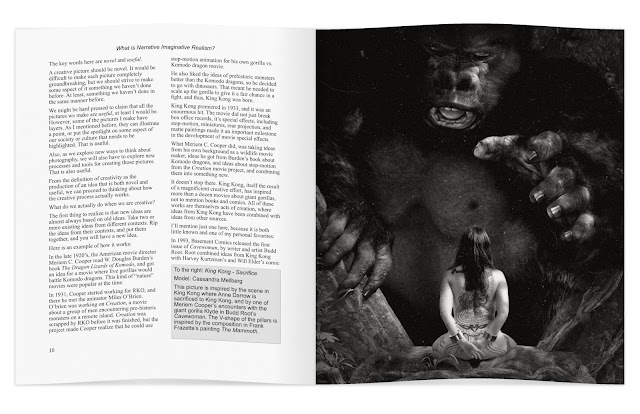
Drawing photography inspiration from King Kong isn't a new idea. William Mortensen did it in the 1930's. I'm revisiting Skull Island with the help of 3D, and the model Cassandra Mellberg.

I'm writing a photography book! It's about creative photography, and it's shaping up to be different from any other book on photography I've seen.

Most photographers learn exclusively from other photographers. I believe that is a mistake. We should learn from each other, yes, but we also need to open up to learning from other sources: realist and imaginative realism painters, comic book artists, 3D artists, movie makers, and writers.

We need to understand our own history, because photography did not begin with the f/64 group, and there is great value in what was before. We even need to go beyond the arts, and learn from other sources, like neuroscience.

I'm striving to tie many different threads together into a coherent whole, and I'm doing my very best to make it entertaining and fun.

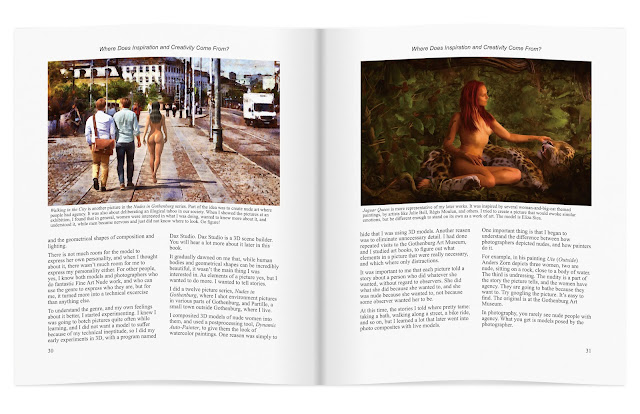
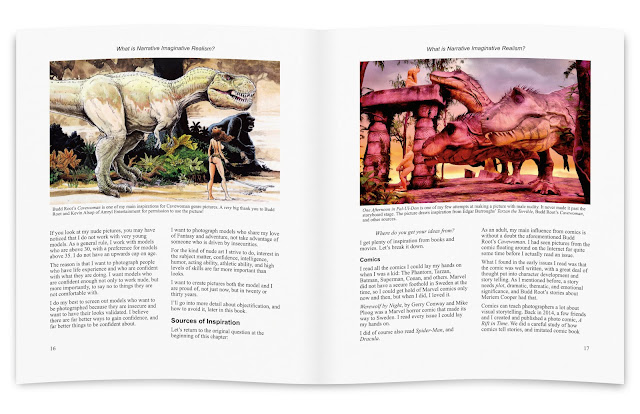
Left page above: I draw a lot of inspiration from comics, so I was more than delighted when Amryl Entertainment gave me permission to use a picture by Budd Root in the book. Budd Root is the author of the comic Cavewoman.

Right page above: I am storyboarding my ideas using 3D software. This allows me to plan my pictures in ways I could not do if I just picked up my camera and shot whatever was in front of my lens. This storyboard, One Afternoon in Pal-Ul-Don, draws inspiration from E.R. Burrough's Tarzan books.


I strive to have something eye-catching, and something useful, on every page spread. From time to time, I will publish a draft page spread, and check the responses to see if I am on the right track.
 various ideas on 
I expect the book project to keep me occupied for about a year. During that time, I also need to do at least a couple of photo sessions, to get material that illustrates various ideas and techniques.

I do hope you will enjoy reading the book as much as I am enjoying writing it!

Sunday, 4 July 2021

Symbolism: Slaying Raptors, Gods, and Our Most Cherished Delusions


Raptor Slayer

You may have noticed that there are a lot of symbols in my pictures. I also tend to stick with certain themes, though I do make the occasional deviation.

Let's have a look at two recent storyboards, and decode some of the symbols in them. We'll start with Raptor Slayer above.

At first glance, what you see is probable something like nude woman stabbing over-sized parrot with teeth. That is certainly one way to look at it, but there is a little bit more to it:

I see a woman mastering her fear, and despite her vulnerability, that's the nudity, fighting very hard to accomplish the almost impossible, i.e. killing a raptor with a bone knife.

I find that never-give-up-even-in-the-face-of-great-difficulty attitude both admirable and attractive, so yes, the nudity makes symbolic double duty.

Of course, as an observer, you will have your own way of interpreting the picture, based on your values, your experience, your knowledge of the Lost World genre of literature, movies, and art, your social context (i.e. the opinions of your friends, and other people who influence you).

Nubian Queen I: The Death of Sobek

The Death of Sobek is about the importance of critically evaluating our own beliefs, and, when those beliefs do not hold up to scrutiny, killing them off and replacing them with something new and better.

Unexamined beliefs, beliefs that are unsubstantiated by evidence, and who do not hold up to even cursory scrutiny, tend to rule our lives.

For example, you might believe that the best way to boost the economy, is cutting taxes for the rich, so they can invest more, and thus create more and better jobs. Well, according to research on tax cuts in 18 OECD countries, that is not how it works. All that happens when you lower taxes for the rich, is that they get richer:

“Our findings on the effects of growth and unemployment provide evidence against supply side theories that suggest lower taxes on the rich will induce labour supply responses from high-income individuals (more hours of work, more effort etc.) that boost economic activity. They are, in fact, more in line with recent empirical research showing that income tax holidays and windfall gains do not lead individuals to significantly alter the amount they work.”
-The Economic Consequences of Major Tax Cuts for the Rich, by David Hope, Julian Limberg

Feel free to disagree, but if you do, bring research that support your views.

The supply side economics scam has kept political parties alive, and sometimes in power, for decades, to the detriment of all of us, except the very rich people who benefit from the tax cuts.

There are plenty of other common beliefs that do not stand up to scrutiny:

For example the idea that a company can maximize its profits by having everyone work as much as possible all the time. This is an idea from Frederick Taylor's Scientific Management. The problem with it, is that if everyone works at full capacity all the time, you get enormous queues of unfinished material, so-called Work In Process (WIP), in your processes. In extreme cases, you get so much WIP, that nothing ever gets finished. This sometimes happens in software development, but it can, and does, happen in other areas too.

There are plenty of ways to reduce, or eliminate, the problem. In management, you can use Lean, Theory of Constraints, agile software development methods, the Deming Knowledge System, IOHAI, and other methods.

Most companies who implement these methods and frameworks do so, not because they understand how they can help alleviate the problems, but because it has become a fad. When you do that, you will almost certainly do things that short-circuit the new way of doing things, so that you go through the motions, but never get the benefits.

For example, agile methods, mentioned above, rely on something called vertical slicing to create work packages that can be implemented with an optimal balance between capacity cost and queueing cost. Over the past 20 years, nearly every company I have seen, has fallen into the trap of doing horizontal slicing, i.e. requirements are functional, rather than representations of something that has economic value on its own.

As a result, lead times can explode. I have seen lead times go up by a factor of 50, and more, because of this. That means you would have to wait for two years to get something that could be built and delivered in two weeks. Thus, you loose the money you could have made by using that functionality for two years.

Another favourite: You want to implement one of the methods mentioned above, and realize you need new processes, so you decide to invest in a tool for creating the new processes. Looking around for a good, safe, alternative, you decide to go with something like IBM Blueworks. Nobody gets blamed for buying from IBM!

What you do not realize, is that all of these new methods and frameworks, separate process material flow from the flow of directives, and that the flow of directives go in the opposite direction from the material flow. The reason for this, is that it is much easier to reduce the amount of WIP, and thus queueing costs, that way.

Blueworks does not allow you to design processes like that. It does not separate material flow from flow of directives. Topping it off, the economic simulation in Blueworks takes only capacity cost into account, which means you are liable to design processes with sky-high queueing costs.

Suddenly, your unexamined beliefs about tax cuts, how to write requirements, or which tool to use, has become your Sobek, your crocodile god demanding human sacrifice.

It's not just about whether you can slay it, you probably do not even know that you should, and you live in a society of Sobek worshipers that will punish you if you try.

I bet you did not think of Nubian Queen I: The Death of Sobek in those terms. Symbolism is tricky, and symbols can be open to an infinite variety of interpretations.

Because of this, the symbolism in a picture is liable to misfire if we do not talk about what it represents. Often, a picture is just a cool image, without deeper connotations, but we won't know that either, unless we talk, or write, about the picture.

So, lets talk about the pictures we see, and the pictures we create. Otherwise, their meaning can all too easily get lost.

Be seeing you!

Tuesday, 2 February 2021

Fishing Trip, and other Storyboarding Adventures


Fishing Trip

I haven't blogged regularly in awhile, so I have quite a backlog of storyboards I haven't published here. The reason for not blogging is simply that, since I can't do any photo sessions during the pandemic, I haven't had any finished pictures to show.

On the upside, once I can start shooting again, I have storyboards enough to last for years. I have included just a few of them in this post. I do hope you find them interesting. I have lots more material, so I'll try to catch up over the next few weeks...or months.

About Fishing Trip:

It is Lost World genre picture of course. I never get tired of them. It is the combination of storytelling, extreme drama, and the connections to a rich lore of literature and movies, I think, that makes them so compelling to me.

I'm going with layered storytelling here:

We see the end of a fishing trip. It was almost certainly a dramatic one, because of the size of the fish the protagonist caught.

Then there is the matter of the attacking spinosaur. That story is unresolved, with our protagonist in immediate, mortal peril. Will she die? No, at least not in my imagination. She will probably loose the fish though. 

There is also the possibility of a deux ex machina resolution, where a mosasaur or megalodon emerges from the depths and makes a quick meal of the spinosaur. I prefer stories where the protagonist survives because of her own wit, strength, and skill though, so, if I wrote the story down, I probably would not go that route.

Since I started shooting in a makeshift studio, I have avoided camera angles that make composition with 3D elements more complicated. I am deliberately trying to get away from my comfort zone, because, with just a little camera tilt here and an odd angle there, I can add more drama, and make the pictures more interesting. There is a limit to what I can do in the studio, mainly because it has a ceiling that is quite low, but I should be able to push it a little bit.

A consequence is probably that I'll make more pictures where the protagonist is kneeling, sitting, or laying down. It is an example of how constraints in the world around us, shapes the solutions we create.

Here are a couple more pictures:

Werewolves of London

I got the idea for Werewolves of London from the song of the same name, by Warren Zevon.

Even though the storyboard turned out well, I am not certain I will make a finished photo composite out of this one. The reason is that the protagonist is a bit too sad and dejected for my taste. I like pictures with an active protagonist, fighting on, no matter what the situation.

One option would be to create a series of pictures showing scenes from the same storyline. Then I am perfectly fine with showing both dramatics up and downs.

Shai-Hulud

Shai-Hulud is of course based on Frank Herbert's book Dune. I intended it as a storyboard, but the way it turned out, I do not know if there is anything to gain by making a photo-composite version.


Kermit the Conqueror

Kermit the Conqueror is a spoof on old Conan movie posters from the 80's.

Kermit the Conquered

I wasn't happy with the woman at Kermit's feet, so I had to reverse the roles in Kermit the Conquered.

Much more to my tastes.


A Plague of Demons

A Plague of Demons borrows its title from a book by Keith Laumer. Laumer's book is a Science-Fiction novel, and a very good one. Except for the title, my picture and the book have little in common.

That is it for now! Be seeing you!


Monday, 21 September 2020

Shooting Horrors from the Beyond with Eliza Sica, Part 3


Jaguar Queen. Digital Paint version. Model: Eliza Sica

I am still working on pictures from my photo session with actress and model Eliza Sica. I have long wanted to do a Woman with Large Cat picture. 

This is a perennial favorite among artists. Frank Frazetta's magical Cat Girl is probably the most well known. Frazetta painted several different versions of Cat Girl, and the final one is pure magic. The different versions are in a new Frazetta art book published by Vanguard. I highly recommend it. It was sold out at the publisher, but I managed to buy a copy from Amazon in Germany. A second printing is in the works.

I did a bit of research, and one painting that left me thunderstruck was Julie Bell's Sanctuary. If you click the link, you'll see that it looks good even on Instagram. Quite a feat.

Another important source of inspiration was an oil painting by Régis Moulun.

Jaguar Queen. Photorealistic version. Model: Eliza Sica

I am quite happy with how Jaguar Queen turned out. Eliza did a great job, and the jaguar didn't eat anyone.

Glory Road. Photorealistic version. Model: Eliza Sica

The first edition of Robert Heinlein's Glory Road was published in 1963. In 1974, Delta Science-Fiction published a Swedish translation. I was twelve years old at the time, and a voracious reader. I hesitated a bit before borrowing the book at the library, because on the cover it had a painting of a scantily clad woman who had apparently slayed a dinosaur-like creature with a bow and arrow.

I did not know it at the time, but the artist who had painted the cover was Bruce Pennington. Pennington's image stayed with me through the years. I do not want to be derivative, but now and then, I recreate something another artist has made, to learn, or to get it out of my system.

When Eliza and I decided to do the photo session, I took the opportunity to make a version of the same scene in the book, heavily influenced by Pennington's painting.

I made some changes. The woman in Pennington's painting, Star, is blonde, and the man walking behind her, Rufo, is white-haired. Eliza is a redhead, so my version of Star would get red hair too.

Rufo, despite looking a lot older than Star, is Star's son, so I gave him somewhat faded red hair too.

The picture was fun to make, and I really needed to get Pennington's picture out of my system. If I do another Glory Road inspired picture, I think I can free myself from Pennington's book cover painting, and do something more original.

Train to Hell. Model: Eliza Sica

Train to Hell is a Lovecraftian horror picture. A detective is investigating a series of disappearances from underground train stations, and suddenly finds herself face to tentacles with an ancient horror.

We shot three different pictures with Eliza as the same detective, so there are more pictures in the same series on the way.

Crash Site Battle. Photorealistic version. Model: Eliza Sica

The somewhat unimaginatively named Crash Site Battle belongs to the same series of pictures as Castaway, a picture I wrote about in the second part of this article series.

The idea is that it is a couple of years after the crash landing in Castaway. Our protagonist has made a place for herself in a tribe of humans. If you wonder what a tribe of humans are doing on another planet, I suggest you read Jack Vance's books about Adam Reith and his adventures on Tschai.

You might notice that there is a lot of stuff going on in this picture. As the battle on the beach unfolds, a starship is coming to the rescue. Whether they will have time to land before the battle is over, that is a different question.

If you look at the crashed, and rusted, starship in the background to the right, there is a second battle in progress. A tentacled sea creature has attacked a woman and her, remarkably pterosaur-like, flying steed, just after they landed on the wreckage. In the sky above, her friends are moving in to help.

Even though I knew you'd barely be able to see it, I set the background battle up carefully. In a future photo session, I might make that battle the focus of a photo series.

For now, the only thing I have is a quick sketch of one of the riders.

Quick storyboard of one of the flying combatants in the background battle.

That is it, for now. I hope you enjoyed looking at the pictures, and wasn't too bored with my scribblings.

My plans right now, is to start planning a new photo session, and finish one or two more pictures from the photo session with Eliza Sica. I have also begun a rewrite, and translation into English, of one of my books. That will take quite some time to finish...and then, of course, there is my day job.

If you haven't seen part 2 of this blog series, click on this link!

Be seeing you!

Sunday, 23 September 2018

Kyla: A Gift for the Queen

A Gift for the Queen
Much as I like the Fantasy art of the 80's, there are some things that disturb me. For example, the frequently recurring theme of subjugation of women by implied or overt force. While Fantasy art may have improved a bit, I do have some doubts whether society at large has become more gender balanced, or if the gender biases and prejudices are merely better hidden.

One way to bring gender issues to the fore, is to flip the roles around, so I did.

If you want to see a couple of variants of this picture, check them out at ArtStation.

Sunday, 12 August 2018

Öland Nudes III: Eve

Öland isn't the Garden of Eden, but it is a beautiful island. The landscape is to a large extent open grassland. Here and there you will find small forests of windblown trees.

Eve started out as a jungle theme picture, but I changed my mind early on. I wanted to connect the picture to one of my ongoing series, so it was either adding spiders and turn it into an Arachnophobia picture, or change the setting to Öland, and make it a part of the Öland Nudes series. I chose the latter.

Sometimes I wonder if you have to be lonely to do any kind of artistic work. I wrote my first book in 2008-2010, during a period when I felt very lonely.

Since then, I have found that I am more productive during periods of loneliness and sadness. When life takes a turn for the better, the urge to create does not disappear, but it is muted. Perhaps because I feel I may have a future, may not just survive, but live and be happy, after all.

I started a new job a week ago, and I feel pretty good about it. I'll be busy working, something I really look forward to.

That leaves less time for photography, and all the weird stuff I do to create my pictures. I probably won't have time to write another book either, at least not for some time.

The one project I want to return to and focus on this year, is Alice: Demon's Gate. We'll see if I can manage a full time job, and work on a graphic novel at the same time.

Friday, 10 August 2018

Gothenburg Nudes XII: Naked Juice Bar

The 12th, and probably final picture in the Gothenburg Nudes series. I started the project because I was a bit tired of seeing pictures that objectify women. I wanted to create a series of nude pictures where nude human bodies are just appreciated for what they are: beautiful.

I have done that to the best of my admittedly meager abilities. It is time to move on to something else, unless, of course, I come up with an interesting idea.


Friday, 20 July 2018

Pictorialism vs. Neo-Pictorialism vs. Contemporary Pictorialism

Bareback Riders - Pictorialist Version
In this article I will use the same basic photo to create three very different pictures, a pictorialist version, a neo-pictorialist version, and, for want of a better term, a contemporary pictorialist version.

Hang on! You are in for a ride!

The slow bit: A brief history of pictorialism

 Pictorialism is a photographic style that was popular from 1885 to about 1920. The style all but disappeared for a long time, but it was rediscovered in the 90's.

The rising interest in the original pictorialists and their pictures, also kindled an interest in recreating their style. Behold, neo-pictorialism was born!

Neo-pictorialist pictures are stylistically very similar to pictorialist pictures, but there are important differences. If there weren't, this article would end here.

What about contemporary pictorialism? First of all, I invented the term. There are people today, who do what the pictorialists did a hundred years ago. Because there is a 100 year gulf separating the original pictorialists from the contemporary ones, the technology has changed, our society, and social norms, have changed. Therefore, a contemporary pictorialist picture can look very different from a pictorialist picture from 1918.

Enough with the history lession! Let's get on with creating the pictures!

The boring base photograph

Base Photo: Bushes and Borgholm Castle
The base photograph is a picture of some boring shrubs. You can see the Borgholm Castle in the background, but as castle photos go, this one is pretty much a dud. The castle is very interesting, but you cannot see that in this picture.

Let's take this unremarkable photo, and have some fun with it!

Neo-pictorialist version

Bareback Riders: Neo-Pictorialist Version. Note the absence of horses and riders.
Let's begin by giving the picture the neo-pictorialist treatment. When people talk about creating pictorialist pictures today, they usually mean neo-pictorialist pictures.

Neo-pictorialism is mostly a technical exercise. The objective is to make a picture stylistically similar to an old pictorialist picture. The closer you get, the more you have succeeded.

Pictorialists in the early 20th century wanted to evoke emotion. They wanted to create art. To do that, they turned to painters for inspiration. Consequently, they often wanted their pictures to look like paintings.

To create painterly effects, the pictorialists used a great variety of tricks. Anything that worked was okay to use. They often blurred their pictures, they hand-colored them, dodged, burned, used early composition techniques...

Neo-pictorialists recreate the look of the pictorialist photos, much like historical reenactment societies recreate old battles.

Thus, if we take our base photo, and make it look stylistically like a pictorialist photo, then we have a neo-pictorialist photo.

Why are there no horse and riders in our neo-pictorialist version of the photo? Because there is no reason to have them there. Only the style is important. The content does not matter, as long as it does not look too modern. Consequently, neo-pictorialist pictures are often pictures of nature, landscapes, forests. A really old car is okay to shoot, but a modern car is not. To some neo-pictorialists, shooting with old lenses and using the original processes is a matter of pride.

Pictorialist version

Bareback Riders: Pictorialist Version
In the pictorialist (1920) version of the photo, the style is exactly the same as in the neo-pictorialist version, but the content is different. Why?

Because, to a pictorialist, content was important. Pictorialists asked questions like:

Is it beautiful?
Is it scary?
Does it tell a story?
Does it convey an idea?
...and so on

A pictorialist uses whatever means available to further the purpose of the picture. It is that simple.

They did not care about using the "correct" process, or whether the picture conformed to genre conventions. They used whatever means they had. The style is as much a result of technical limitations, as of aesthetic considerations.

For this picture, I have stuck with the convention of making the photo look like a painting, but the technique I use for doing so is completely modern. In case you are curious, I used Dynamic Auto-Painter, a tool that analyses the photo, and with a little guidance from me, recreates it from scratch, as a painting.

Making their pictures look like paintings was a means to an end, not an end in itself. It was a convenient way to help viewers relate to the photos by relating the photos to something the audience already knew. (A bit like when the iPhone was introduced. The iPhone is a miniature mobile multi-purpose device. Most of the time it is used, it is used as something other than a phone. Calling it a phone made it easier for people to relate to it.)

Nudes are common in pictorialism because the nude human form evokes feelings. Most pictures are of nude women, because most of the photographers were male. There are exceptions though. There were female photographers, and photos of nude males.

Note the difference between pictorialist and neo-pictorialist:
  • The pictorialist uses cutting edge technology and processes to express emotion and ideas.
  • The neo-pictorialist tries to emulate the results of processes used by pictorialists in the period 1885-1920.
What would a pictorialists do today? I am glad you asked.

Contemporary Pictorialism

Bareback Riders: Contemporary Pictorialism
A contemporary pictorialist would ask the same, or similar, questions that a pictorialist would:

Is it beautiful?
Is it scary?
Does it tell a story?
Does it convey an idea?
Do I have to ask exactly the same questions a pictorialist would have asked 100 years ago? (Hint: The answer is NO!)


If you have read my blog posts about the Gothenburg Nudes series, you know that the basic idea was to separate nudity and objectification, for the purpose of making room for appreciation.

This basic idea guided the design of each picture, and of the series as a whole. The Öland Nudes series uses the same basic idea, but it is tailored for a slightly different audience.

People tend to relate to places they know, so I use familiar locations to trigger interest, before I hit t
hem with abstract concepts.

I admit, it does not work perfectly. Some people see nipples, and after that, they see nothing else. This happens both with those who like nipples, and those who don't. Neither group is my target audience.

My target audience is the group of people who appreciates both the beauty of the human form, and abstract reasoning...and especially those who either live in Gothenburg or on Öland.

If you live elsewhere, please do not feel left out. You can appreciate Gothenburg and Öland even if you do not live there.

That is the difference between pictorialism, neo-pictorialism, and contemporary pictorialism as I see it. Feel free to disagree. If you do, please also feel free to comment. I am interested in your opinion, whether your argument changes my mind or not.
Tuesday, 10 July 2018

Gothenburg Nudes XI: Reflections at the Pond

 Reflections at the Pond is the eleventh picture in the Gothenburg Nudes series.

I had planned a visit to the Gothenburg Botanical Garden to find a suitable environment for one of the pictures.

Two of my friends in Photo Meetup in Gothenburg, Kristina Johansson and Sina Farhat arranged a Short Depth-Of-Field themed meetup in the Botanical Garden. That was perfect for me. It was an opportunity to dust off my macro lens, which was long overdue. Even better, it was an opportunity to meet a few of my friends.

I do meet my friends more often than I bring out the macro. Still, meeting them was long overdue too.

And, I got to photograph two birds with a single click. (Killing them with a single stone sounds too harsh.) After practicing shooting with short Depth-Of-Field, we went exploring for a bit. I got separated from the others, stumbled on to a pond where the water was a still, perfect mirror, and...voila! I had exactly the environment I was looking for.

After shooting the pond, I discovered I was actually just a few meters from the rest of the gang. I joined them, and we left the garden together.

If you want to see how I created the picture, check out the project at ArtStation.

Wednesday, 27 June 2018

Gothenburg Nudes VIII: At the City Library


The Gothenburg City Library is important to me. I love books. I like the café, where I sit and work from time to time. Did I mention I love books?

So, I had to include at least one picture from the City Library in the Gothenburg Nudes series. This is the one...except, maybe it isn't.

When I work on a picture I often get ideas for more pictures. That is what happened when I worked on this one. So, maybe I'll make another City Library picture. Maybe two...

I think I need to go back to the library real soon, and see if I can come up with a couple more ideas.

Monday, 25 June 2018

Gothenburg Nudes VII: Bathing Women

I am used to cloudy, windy, and rainy Gothenburg summers. This year, we are having a great summer. Thus...bright, sunny pictures to reflect my bright sunny mood.

I am getting more and more convinced I should recreate at least some of the pictures in this series with live models. It'll be interesting to study the differences.

I published a couple of these pictures in a Swedish art forum on Facebook recently. This sparked an interesting discussion on the importance of art that pushes boundaries. Depending on your point of view, a picture of nude people bathing, or engaged in other activities, is nothing especial, or it can make your brain explode. A picturecan be beautiful, unremarkable, or immoral, depending on who views it.

What art can do, is provide us with a new perspective on what is acceptable, and what is not. I see a lot of pictures, ostensibly art, that are objectifying, and that denigrate people, especially women. I want to help provide a counter-weight to that, by showing that nudity is not the same thing as objectification.

If you are interested in how this picture was created, check out ArtStation. There you will find a sequence of pictures that shows the process in a bit more detail.

Oh, if you are interested in how a painting helped change our view of sexuality, and made us a little bit more open-minded, check out this Wikipedia article about Le Sommeil, by Gustave Courbet.

Sunday, 3 June 2018

Gothenburg Nudes II: A Stroll in the Park


After publishing Walkabout, I decided to get out a bit more, and to bring my camera. I wanted to shoot reference photos at easily recognizable locations in Gothenburg. Maybe I could turn those quite ordinary locations into something more interesting.

I have done similar things before, but mostly for Fantasy and Science-Fiction themed photos. This time, I wanted to continue exploring nude art.

While I sometimes do model shoots with traditional model poses, I usually prefer pictures with people who do not look like they are posing. I want the camera, and me, to be as unobtrusive as possible.

The same thing goes for a 3D picture or digital painting. I like people who do their own thing, without the need for approval from me or anyone else, and that shows in my pictures.

Please do not get me wrong. We all need to be appreciated, for what we do, and for who we are. I believe it is far better to find people who do appreciate you for being you, and for pursuing your interests, rather than you trying to adapt what you do and who you are to someone elses notions of what is interesting, attractive, and otherwise worthy of notice.

If you deviate from the norm in a noticeable way, you probably won't find many people who really appreciate what you are, so try to be careful to appreciate them in return. It is worth the effort. I know, both because there are people in my life whom I appreciate very much. Sadly, I have sometimes let friendships, and other relationships slip, and I am the poorer for it.

With the Gothenburg Nudes series of pictures I want to capture the feeling of just appreciation beauty, seen and imagined. I want to spice up the ordinary a bit, which is why I have chosen various locations in Gothenburg as locations for the pictures.


Thursday, 24 May 2018

Walkabout (a.k.a. How to apply The Art of War to Photography)

Cheng/Chì (Ortodox/Unortodox) is an idea from Sun Tzu's book The Art of War, that says that to win a battle, you need two things: Ordinary military forces, doing the tried and true things, and unorthodox forces, creating an element of surprise. The principle can be applied to any other art, as well as the art of war.
I used to do a lot of street photography. It is an easy way to get started in photography, but it is also one of the most difficult photographic genres for the simple reason that most of the time, there is nothing noteworthy to shoot.

I followed the rules when shooting street photos, but I also started doing other kinds of photos. Still with a city environment as background, but with a dinosaur, or a spaceship, slipped in to make the picture more interesting.

I haven't done that in awhile, so maybe I should start doing it again.
Technically, this picture is mostly an exercise in tone mapping and saturation mapping. I started using the techniques recently, and I am not entirely happy with them yet. Next time, I intend to work in 32 bit mode all the way through the process, to see if that makes a difference.

Practice

Knowledge is of no value unless you put it into practice.
― Anton Chekhov
You may wonder, "why so many nudes lately?" Good question. I wish I had a really good answer, but I don't. Here is the closest I can come at the moment:

When I started with photography, I shot a lot of flowers to learn the basics of composition, and how to handle my camera in various lighting situations. I mean a lot of flowers! I shot more than 8,000 the first year, and more than 13,000 the second year. I was out shooting three times a day, every day.

After that, I was kind of done with flowers, but I had learned a bit about photography. After that, I did street photography, model photography, macro photography, levitation photography, flesh manipulation photography, portrait photography, some art photography, even tried my hand at pin-up photography.

Now, with nudes, I have found something as interesting to me as horror, Science-Fiction, and Fantasy photography. I want to learn more, and I want to integrate the nudes with the kinds of photography I've done earlier.

I have always been that way. I used to be a programmer, so I learned programming languages, then techniques of Object-Oriented programming, then design patterns, then project methodology, then systems thinking, queueing theory, Theory Of Constraints, statistics, military strategy, Chinese and Japanese military strategy...

And, I integrate it. I synthesize.

While I do not intend to do 21,000 nude pictures, there will probably be quite a few more, before I have integrated them fully in my repertoire.

Cheng/Chì

“Engage people with what they expect; it is what they are able to discern and confirms their projections. It settles them into predictable patterns of response, occupying their minds while you wait for the extraordinary moment — that which they cannot anticipate.”
― Sun Tzu, The Art of War
If you read the picture caption, you already know that Cheng/Chì (Ortodox/Unortodox) is an idea from Sun Tzu's book The Art of War, that says that to win a battle, you need two things: Ordinary military forces, doing the tried and true things, and unorthodox forces, creating an element of surprise.

The principle can be applied to any other art, as well as the art of war. So, in the picture above, the street with all the ordinary people is the cheng, and the nude woman is the element of chì.

So, now you know how to apply the Cheng/Chí principle from Sun Tzu'z The Art of War.

Get out there and practice!

PS. The GDPR Thing!

You might wonder whether a picture like the one in this article breaks the new General Data Protection (GDPR) law. It does not. Journalistic images and art are exempt from the rules. That means it is okay to do street photography, it is okay to create digital paintings from street photographs, and it is okay to manipulate a photo taken in a street, if the purpose is to create a piece of art. You can read up on GDPR here.

Saturday, 19 May 2018

Kyla: The Most Dangerous Game


I saw a simple sketch by the comic book artist Frank Cho recently, where he created an amazingly dynamic composition with a (for him) very simple sketch.

It got me thinking about composition, and circular composition in particular.

Frank Frazetta sometimes used circular composition, for example in his Winged Terror. More often, he used very strong triangular composition, as in his Conan picture Chained and in Luana from 1973.

Frazetta was a master at capturing movement. Look at his sketch Pellucidar. Note the similarities to Frank Cho's sketch. (You did click the link, didn't you?). Frazetta uses triangular composition in his sketch, and Cho used circular, but look at the way they have captured the movement!

Stunning!

So, why does my picture use triangle composition instead of circular composition? Because I realized that to make the composition circular, I would need to rotate the body of the guy in the space suit so that his body is more or less perpendicular to the viewer.

I goofed! I should have sketched everything out more carefully beforehand. Instead, I pushed on with the picture, and did not consider the whole until it was too late.

A contributing factor was that I wanted to use portrait format. The ideal format for a circular composition would be a square (I think...I am fully prepared to change my mind once I learn a bit more.)

In the end, I decided triangular composition is good enough for me, right now. Maybe I'll go circular next time...or not.

I used the DAZ Studio default HDRI image set at 0.3 strength for ambient lighting, one spotlight behind the characters to light contours, and a second spotlight straight above. I used spotlights with large surface areas, to get fairly soft shadows.

I brightened the green suit quite a bit in post. The trouble with camouflage spacesuits is that...well, they are camouflaged.

Finally, I painted the whole thing in Dynamic Auto-Painter.

Thursday, 17 May 2018

Kyla: The Hunting of the Snake


The title of this piece, The Hunting of the Snake, is a horribly bad pun. I got the idea from Lewis Carrol's poem The hunting of the Snark.

There are many different interpretations of the poem. Lewis Carrol was once asked if it was an allegory for the search for happiness, and he wrote in a letter that it was.

I have always been fascinated by the last two verses:

 They hunted till darkness came on, but they found
   Not a button, or feather, or mark,
By which they could tell that they stood on the ground
   Where the Baker had met with the Snark.

In the midst of the word he was trying to say,
   In the midst of his laughter and glee,
He had softly and suddenly vanished away—
   For the Snark was a Boojum, you see.

Happiness is a Snark. We hunt for it, but when we catch it, it may well turn out to be a Boojum.

Well, unlike the Baker, at least most of the time, we can survive the Boojum, and live to hunt another Snark. Some of us even find it.

In case you wonder, I made the picture first, and came up with the title, and thus also the interpretation, afterwards.

I suppose, it is a case of cause following effect.

Technically, I created the original picture in Daz Studio.


I used three lights for this picture:
  • The default DAZ HDRI environment, set at 0.3 strength. This gave me a basic low level ambient lighting. The level you can see in the background.
  • A spotlight with 10x10 m area, placed 10 m straight above Kyla and the Constrictor. This gave me a fair amount of light on the trees beyond the large fallen one, and brightened Kyla and the constrictor a bit.
  • A smaller spotlight, 5x5 m, 8 m up, with a more narrow beam of light, focused on Kyla and the constrictor.
The end result is that the further away you get from Kyla and the snake, the darker the picture becomes. Some of my recent pictures have had to flat lighting, and I wanted to fix that.

I painted the picture using Dynamic Auto-Painter.

Here is the first version. I wasn't quite happy with it. I think you can see why:


In this version, the background trees are almost obliterated by the muddy, brown underpaint. I had decided to leave reduce the detail in the background, but the DAP default was a bit too much.

Simple solution: I did a bit of post brushwork in DAP. The reason I mention it, is because if you do the same, do set the opacity of the brush down a bit. The postprocessing brushes have higher default opacity than the same brush used while DAP is autopainting. This can trick you into making postprocessing effects too strong.

Tuesday, 1 May 2018

Kyla: Interrupted Service


I noticed that I was slipping back into my old habit of showing a scene either before, or after, something happens, but not during. So, I decided to break the habit.

My previous Kyla blog post showed her facing off with a giant Deep One, built more like the Abomination than the creatures H.P. Lovecraft describes.

I wrote that I would trim the Deep Ones down a bit, and that is what I did. I kept the bodybuilding one, but all the others are a more normal size. As you can see, I also made sure that particular Deep One won't bother anyone again.

I do have a couple more ideas for a large Deep One though, so he just may reincarnate...eventually.

The title Interrupted Service is a joke. My son would tell me it is a very lame joke, if I asked him about it, so I won't.

If you look to the left, you'll notice a foot and a pair of legs. I won't tell you who it is, but it is the same guy who is in trouble over here. Click the link if you are curious. Some people just won't stay rescued.

I had quite another idea in mind when I started out with this picture, but I got into trouble, and decided to simplify a bit. I haven't given up on the original idea though, so I might do some more work on the same theme.

Saturday, 28 April 2018

Kyla vs. Deep One (Cthulhu Mythos Meets Cavewoman)


One more Kyla picture. Kyla vs. a Deep One. A very, very muscle-bound Deep One. :-)

The interesting thing to me, is that if I can create a passable Deep One, it opens up a whole range of storytelling. The Cthulhu mythos provides rich, and partially copyright free (check very carefully what is free to use, and what is not, if you do anything commercial) material to base stories on, or to weave in as story elements.

I will hold a Photos Inspired by Books event on the 12th of May, in Gothenburg. This picture isn't a photo, of course, but the important thing is the sources of inspiration. In this case:
  • The Cthulhu Mythos created by H.P. Lovecraft, and developed by many different writers.
  • Marvel/DC Comics superhero comics. Yeah, there is a reason for those overdeveloped muscles. Check out Marvels Abomination.
  • The Cavewoman comic by Budd Root. Technically, Cavewoman belongs to the Lost World literary genre, which is a sub-genre of Science-Fiction. By the way, so does Jurassic Park and King Kong.
So, there are three major literary sources of inspiration for this picture. I believe that in order to create something new and interesting, whether it is a picture, or anything else, you need to stoke the fires of your imagination with many different kinds of fuel. Indeed, creativity is the ability to deconstruct those sources, in order to build something new.

There is more of course. I have written before, about how Kyla herself is a result of playing with genre conventions, and flipping gender roles. Kyla fights monsters, she is no damsel in distress. (She has been quite distressing to some people in Facebook art groups though, who prefer more demure, and more fully dressed, women.)

A little bit about the technical side of creating the picture:

The Deep One is a Michael 4 3D mesh with Creature Creator and The Freak morphs. I used the Daz Studio Leather shader for the skin, and changed the skin color.

I rendered with Iray in Daz Studio, tweaked the picture (strategically placed hair and a bit extra brightness and contrast) in Affinity Photo. I worked in 16 bit mode to get a little bit of extra punch in the colors.

Finally, I painted the whole picture in Dynamic Auto-Painter.

Just like there were three different sources of inspiration for the idea, there were three different tools that contributed to creating the actual picture.


Here is the original 3D scene, as I built it in Daz Studio. Whether you prefer the painted version or the original is a matter of taste really. (I doubt anyone who does not like either reads this far.)

While working on this picture, I was actually more concerned with the lighting than the scene itself. The reason? Because this picture is a warmup picture for a slightly more complex picture that I haven't done yet.

Be seeing you!

Friday, 30 March 2018

Lost World IV: Aftermath (a.k.a. Blood on Her Hands)


This is the fourth and final (unless I get more ideas) picture of Kyla.

Yes, I named the character. I thought it appropriate, since she appears in an entire series of pictures, and may appear again.

As you can see, it is immediately after the battle against the T-Rex.

I have written about my sources of ideas for this series in my earlier posts. What I wrote then, goes for this picture too. However, there is one influence worth a particular mention:

Joe Jusko! (Check out his pictures on DeviantArt. It is a treat.)

I have learned a lot just by looking at Joe Jusko's pictures. They are strong, dynamic, the colors are vibrant, the compositions lead the eye to a point-of-interest, but it is more than that. Jusko has something special, Jusko has angles.

No, not angels! Angles! In some of his pictures, he is careful not to overdo it, he uses unusual angles to create drama, and heighten emotion.

I'll link to a couple of his images on DeviantArt. Check them out and you'll see what I mean:

Here are two more. They do not use viewing angle in the same way. I am including them because I like them, and because they have female protagonists that don't take crap from anyone:
  • First oil painting in 1977 (Wow! I didn't know about this one until I researched this blog post. Except for the hair color, the woman could be my character, Kyla.)
  • Stand Off! (If you think the woman looks a lot like La of Opar, it is because she is La of Opar.)
It is very important to know...oh, screw that! I got a new idea for a picture with Kyla. Got to go.

I'll be back!

Monday, 19 March 2018

Lost World I: Dangerous Shadow


I have had the idea for this one in my head a couple of days. The idea is that sometimes, you have to knowingly walk into danger, and take on something that may be too big for you to handle.

This is one picture that I'd like to make a photographic version of. We'll see how that works out.

Where do you get inspiration for a picture like this? Well, I got it from several different sources. The Lost World theme is from books like Arthur Conan Doyle's book The Lost World, and Michael Crichton's Jurassic Park. Edgar R. Burrough's Tarzan and John Carter books are also strong influences.

In case you are wondering about the nudity: It's the norm on Barsoom, where John Carter had his adventures. Also, I budget my 3D projects carefully, and appropriate clothes weren't in the 3D budget for this month, and because I am still trying to figure out how to do nude art.

There are of course artists that have inspired too. The somewhat exaggerated proportions of the woman is inspired by the art of Boris Vallejo, Julie Bell, and Frank Frazetta. The situation, with impending danger, owes more to Joe Jusko, and perhaps FrankCho. (Frank Cho would probably have turned the idea into slapstick comedy.)

Technically, I am a photographer, not a painter, so I take a photographer's approach to creating pictures. That is, I do not create stuff. I take existing stuff, and arrange it on a scene in front of a camera, and take a picture. It just so happens, this time I used 3D objects. and the scene was created in Daz Studio.

Oh, I did a bit of post processing in Affinity Studio and Dynamic Auto-Painter. Dynamic Auto-Painter is quickly becoming a favorite of mine.

I do have a couple of more ideas on the same theme, so this may well turn into a short series of pictures.